
News Team member Ananya Dash recommends the latest episode of Health Storytelling, featuring Jason Gale and his book "After COVID".
What Medicine Can Learn From Nature
Susan Abookire sees forest therapy as a way to combat burnout in the healthcare field.
By Harrison Luba
“Wait a minute, what are you doing?”, Dr. Susan Abookire thought to herself, 2,500 miles from her home in Massachusetts and 30,000 feet above the earth. As an internal medicine physician who had always loved nature, she had decided to sign up for an eight-day forest therapy immersion course in Northern California. The course helped people reconnect with nature to cope with the overwhelming stresses of modern life. Still, “this is dumb,” she thought.
Now, many years later, Abookire has created a course where she guides medical residents in forest therapy to teach them about the healthcare system as a whole. As financial incentives intrude on the way doctors practice medicine, many can’t help but feel that they are a small fish in the overwhelming sea of insurance and pharmaceutical companies. Abookire guides providers through nature to bring them back to why they pursued healthcare in the first place: to help people.
“Forest therapy has a major impact on healthcare professionals’ own wellbeing and their own very deep connection to the natural world,” says Abookire. “It’s also really transformative in the way that they begin to work with their patients. Not just that they have this extra tool, but in the whole way of being with patients.”
Abookire believes that forest therapy can help physicians suffering from burnout slow down, connect with their senses, and develop a relationship with the natural world. The end result is a reinvigorated sense of wellbeing and ability to manage stress. Abookire has seen increasing rates of burnout among physicians, due to being overburdened by administrative tasks and time constraints.
Abookire’s Encounter With Forest Therapy
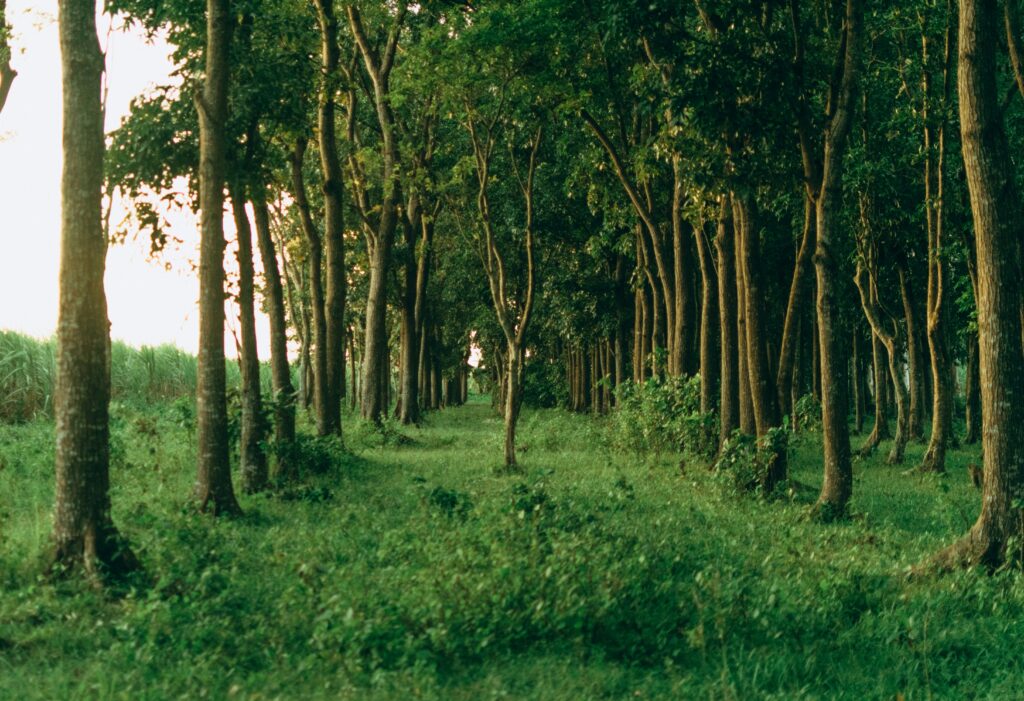
Abookire sees forest therapy as a way to potentially combat burnout in the healthcare field. She explains that forest therapy is a Western practice based on the Japanese technique of shinrin-yoku, or “forest-bathing,” that emerged in the mid 1980s to combat chronic health problems related to their increasingly urban lifestyle. She sees burnout as a problem rooted in parts of an unhealthy medical system. In bringing forest therapy into medicine, she hopes to inspire practitioners to see how healthy systems in nature operate, and bring it into their own practices.
To understand why Abookire sees burnout as a systems problem, it is important to look at her own career path. Before she became a physician, she trained and worked as an engineer, a perspective that continues to shape the way she practices medicine today.
Drawing on her background as both an engineer and a physician, Abookire has turned to forest therapy as a way to restore doctors to the reason they entered medicine in the first place. Her work shows that nature can be a source of relief and a model for healthier systems of care.
Abookire spent the first ten years of her career as an electrical engineer in aviation safety, designing flight management systems. She had always been interested in how large systems operated, and realized early on that they all came down to human factors. The success of aviation systems came down to how flight crews interacted with new technology, and how new technology could better be integrated to help the crew succeed.
Throughout her engineering career, however, Abookire had also been fascinated with how the physical brain, neural networks, and consciousness came together to determine our thoughts and feelings. She went to medical school with the goal of studying neural networks, but she realized there was a problem. The field of neurobiology was still in its infancy when it came to neural networks, and as an engineer, Abookire preferred real-world application to research.
She shifted her focus and received a master’s in public health at the Harvard School of Public Health while witnessing the birth of the patient safety movement. This inspired her to focus on patient safety, and she became the chief patient safety quality officer and eventually chief medical officer. Along the way, she has incorporated nature as medicine into her work, and forest therapy has now become a major part of her philosophy.

Abookire’s Forest Therapy Course
As a physician, Abookire saw many healthcare workers struggle with burnout. Most employees go into the healthcare field to help people. They are then met with a system that overloads them with tasks that aren’t helping patients, which can be exasperating. The solution to burnout, she says, must be a systems solution. She has seen what healthy systems have looked like in nature, and she wants to bring these ideas into healthcare.
“I started creating a pilot course, which we taught at MIT in the Sloan School, trying to teach healthcare leaders what healthy systems look like,” Abookire explained. As she sat in a New Jersey hotel room thinking about this, she stumbled on a magazine article about forest bathing. This was the pivotal moment for her. She realized right then that she didn’t exactly know the details of forest bathing, but she knew she was going to do it.
Abookire took the forest therapy guide course, under the naturalist and professional hiking guide, Ronna Schneberger. Schneberger has over 30 years of experience and is a forest therapy guide and Association of Nature and Forest Therapy trainer. After helping Abookire become a certified forest therapy guide herself, Schneberger realized that working with Abookire was special. She remembers sitting with Abookire at a lunch break and asking “why are you here?” She recalls Abookire explaining that she can give someone a medication for hypertension, but prescribing medicine only accomplishes one thing. Nature has proven health benefits, she told Schneberger, including helping heart rate, stress, and anxiety.
This chance discovery affirmed what Abookire had always believed. Health systems can borrow healthy practices from nature. Since stumbling upon the forest bathing article, Abookire has been laser-focused on integrating nature into medicine and sharing this practice with her peers.
The two formed a connection during the course and remain working with each other today. In fact, they have now developed a course with each other called “Nature as Medicine Practitioner Training.” Abookire has brought in her experience working in the medical field, particularly focusing on burnout, in developing a course teaching healthcare professionals to become forest therapy guides.
“It’s just such a pleasure to work with Susan,” Schneberger says. “We’re very much aligned and we both have insights that we’ll share and we build off each other as we go. Her goal really is to nurture healthcare professionals through nature so that they can get some restoration within their bodies.”
Forest Therapy to Combat Physician Burnout
Abookire and Schneberger’s course has room for roughly 25 students, and they have already seen exciting trends from their first group of graduates. Some of the first students from their course have already started integrating forest therapy into their medical practices. One of the graduates is a physician in Ottawa who has integrated nature prescribing in the hospital where she works.
Another graduate of the course, Shannon Liedtke, has been connected with nature her whole life and wants to use forest therapy to help those facing burnout. She was inspired by Abookire’s work and teaching and decided to start her own forest therapy program in Portland, Oregon.
Liedtke agrees with Abookire about the causes of burnout in the healthcare field. “The people who want to help other people are often willing to give more than they should and don’t have great boundaries around taking care of people,” she says. She joined Abookire’s retreat in the Rocky Mountains where all the students met and were oriented to the basic premises of forest therapy guiding. Abookire then led bi-monthly learning sessions on Zoom where she focused not only on how to practice forest therapy, but how it could transform medical care.
One of the most exciting benefits of forest therapy is that it not only helps healthcare professionals combat burnout, but it also gives them skills they can take into their own practices and share with patients. Abookire has begun to study these effects more formally, measuring how forest therapy impacts physicians themselves.
In 2024, Abookire published research on the effects of forest therapy on physician wellbeing. She recruited physicians for a free Forest Therapy guided experience and conducted pre- and post-course surveys to assess burnout, resilience, and feedback on the experience. 85 percent of the subjects initially reported feeling burned out at least once a month, and almost half of them reported feeling burned out multiple times a month. After going through the forest therapy experience, more than 80 percent of physicians stated they believed forest therapy could help them with burnout from work.
The results of the study were overwhelmingly positive. 75 percent of the physicians rated the experience as extremely valuable, and 100 percent of them would recommend this experience for other physicians.
The support of her research and experiences of her peers convinced Abookire that forest therapy was not just restorative, but also teachable. If healthcare workers could learn to see their purpose in the larger system, they could also learn how to reshape healthcare for the better.
Improving Physicians’ Experience in Medicine
Abookire now spends most of her time focused on teaching this systems-based practice course she created, as well as teaching at the Harvard Medical School. She offers this course as a way of offering wellbeing to residents and helping them develop critical skills in being a successful doctor. One of the core competencies that the accrediting organization for residency programs lists is systems-based practice, an area Abookire has proven expertise in.
For years, nobody knew exactly how to teach a systems approach to medicine. There are many questions that systems approaches try to answer. How do healthy systems operate? What is an accountable care organization? How are financials handled? Dr. Abookire focuses on answering how understanding of systems can be used for conflict resolution.
“I’m just a cog in the wheel,” Abookire has heard from her students. In response, she says, “look at the cogs and how they all work together. You take out one cog, the whole thing falls apart.” The goal of understanding systems-based practice is to empower people to see how they are able to change systems. Every healthcare worker can be an agent of change with the right mindset.
Colleagues describe Abookire as both wise and meticulous. She has both the precision of an engineer, and the person-focused perspective of a physician. As a systems thinker, she tries to see how all the pieces come together to make the whole thing work. Away from medicine, she is known for turning her phone off for a week to go fly fishing in Montana, emphasizing her belief that restoration is pivotal.
Abookire envisions a healthcare system that mimics healthy ecosystems in nature. She hopes to see hospitals with biophilic design, letting in natural light and integrating greenery. She also hopes that medical organizations will encourage outdoors time as restoration for overburdened providers. For her, nature is a blueprint for the medical field to follow. Systems thrive when they take care of the people within them.
Healthcare worker burnout is a growing problem that is often framed as a personal shortcoming. Abookire realizes that burnout is a symptom of a system that overburdens, overworks, and undervalues employees. Nature offers an example of what a healthy system looks like. Through forest therapy Abookire has brought nature into medicine to remind doctors that systems can be redesigned and fixed. If medicine learns to follow nature’s example, it can finally care for the healers.
Related Posts